Former Polish Deputy Justice Minister Marcin Romanowski fled to Hungary and was granted asylum. How do you assess Romanowski’s situation, and how does this case affect Hungarian-Polish relations?
From a legal perspective, the case is clear. Romanowski has been charged by the Polish prosecutor’s office with the embezzlement of state funds. These are very serious matters — we are talking about 112 million zloty, roughly 25 million euros. Consequentially, he should currently be in pre-trial detention. That was the court’s decision, but he fled the country because he knows the severity of the punishment he could face. In Poland, democratic fundamental rights are guaranteed, the rights of the accused to a defence are respected, and both the courts and the prosecutor’s office are independent and impartial. Yet Romanowski still chose to flee. In a manner entirely contrary to EU law, Viktor Orbán then granted him asylum. Polish authorities issued a European Arrest Warrant, which is based on the principle that EU member states can trust one another. In other words, this process should, in theory, be automatic — no one is supposed to refuse it.
What does it mean for Hungarian-Polish relations that the Hungarian government is refusing to comply?
It is a matter of Orbán protecting his colleagues within the Law and Justice (PiS) party. This has nothing to do with EU law — on the contrary, it violates it, breaching multiple EU treaties. In my opinion, the EU should initiate and infringement procedure against Hungary for this,
as Orbán’s government is aiding and protecting suspects.
The Polish people and the Polish government are awaiting change in Hungary. The question is not whether relations with Hungary are good, because they are not. Of course, Orbán has good relations with Jarosław Kaczyński (leader of PiS) because autocrats protect one another, just as Anne Applebaum (American historian and journalist, wife of Polish Foreign Minister Radosław Sikorski) writes. However, when it comes to the Hungarian and Polish people, we are brothers throughout history. That is the current situation.

So the situation is bad right now.
Yes, it is – at Orbán’s level. But as far as the people go, we are friends.
The Hungarian government’s propaganda is taking a rather strong stance against Poland. Minister Gergely Gulyás, heading the Prime Minister’s Office, has claimed that Poland is experiencing a rule of law crisis. Meanwhile, Minister of Foreign Affairs and Trade Péter Szijjártó has stated that „the current Polish rule of law situation clearly demonstrates EU leaders’ double standards: if one-tenth of this was to happen in Hungary, Ursula von der Leyen would already be drafting a proposal to deploy peacekeeping forces.”
This is about lies and manipulation. This is the method of all autocrats — Kaczyński, Morawiecki (former Prime Minister), and it is Orbán’s method as well.
We know this; they always lie.
So far, we have have won every lawsuit when we represented individual cases against the PiS government in European courts, as they had violated the treaties of the European Union. The same applies to Orbán — he also loses in European courts. Moreover, investigative journalists uncovered evidence that the Hungarian government had been spying on OLAF, which was investigating the case of István Tiborcz. This has been recently discussed in the European Parliament. Additionally, Orbán is Vladimir Putin’s greatest friend and ally — this is entirely obvious; he is attempting to block, for instance, the freezing of 190 billion dollars in Russian assets.
The Hungarian government claims it granted asylum to Romanowski because his parliamentary immunity was violated in his home country. What do you think about this?
When he was taken into temporary custody last year, he still had immunity. However, his parliamentary immunity was later suspended, as was the immunity he had due to his membership in the Parliamentary Assembly of the Council of Europe. Now, he has no immunity whatsoever, meaning the Polish prosecutor’s office had every right to issue a warrant for his arrest. The crime he is accused of is very serious — stealing public funds from the so-called Justice Fund, which was under the supervision of his ministry.
On 31 January, Zbigniew Ziobro, Romanowski’s former boss and former Polish Minister of Justice, was temporarily detained. He was not arrested at his home but in front of a television station close to PiS, as he was leaving left the building. What is your opinion on this case?
Ziobro is responsible for the destruction of the Polish judicial system. It is also
highly likely that he was responsible for the introduction of the Pegasus spyware in Poland.
We have a parliamentary committee investigating this case, and he was summoned to testify before the committee. Ziobro repeatedly refused to appear. Instead, he turned it into a media circus, going to Republika TV. In the end, the committee is now requesting a 30-day detention for him. However, the key issue here is the serious matter in the background — spying on the opposition, journalists, and lawyers. All this happened after this Israeli spyware was purchased — using public funds.

Ziobro is now free.
Yes, no charges have been filed against him. However, detention is still a possibility, as his deputy, Romanowski, has been charged with offences committed within a criminal organisation — serious charges that could lead to decades-long sentences. Based on this, I find it hard to believe that Ziobro knew nothing at all, but the fact remains that he has not been charged yet.
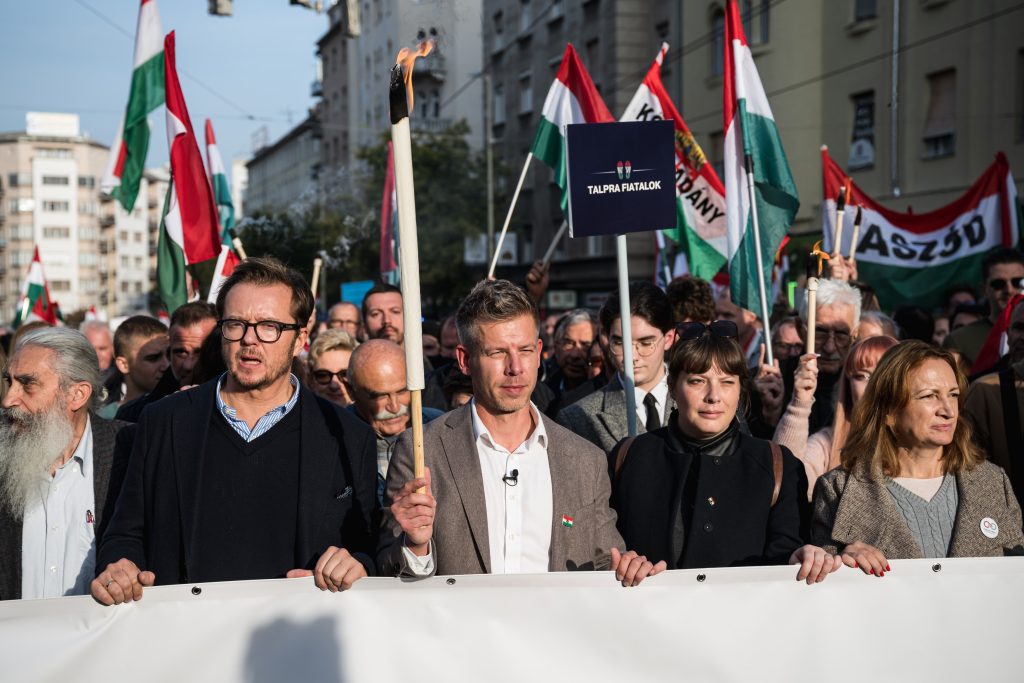
At Tisza Party’s Budapest October 23 rally last year, you said that both Hungarians and Poles want to break free from Russian control. You also mentioned that you felt something similar in Budapest as you did earlier in Warsaw in 2023 when the Tusk-led coalition defeated PiS.
I truly felt that the atmosphere in Budapest on 23 October last year was similar to what we experienced in Poland a year earlier before the elections. We wanted freedom. We wanted to rid ourselves of the authoritarian regime and Kaczyński.
I believe that if the regime collapsed by the Vistula, it can collapse by the Danube as well. Of course, tough times are ahead, and Péter Magyar will have to endure for another year.
„Sooner or later, every dictator’s power collapses.” Who were you referring to when you said this at Bem Square last year?
Naturally, I was referring to Orbán. I firmly hope that all such regimes will collapse. This is the will of the people, even if they supported him in the past. Now they can see that this is a mafia state — a state of corruption and kleptocracy. The regime does not care about the people, the economy is underperforming, people are suffering, and only the oligarchs benefit from what Orbán is doing.
Can an illiberal system, like the one PiS built in Poland, be dismantled through legal means?
In Poland, we still need new laws for this. However, President Andrzej Duda vetoes the bills passed by Parliament. We need a new president because restoring the rule of law is crucial for Poland. The executive branch cannot do everything, so it is up to Parliament to reverse the situation. That is why a new president is needed. There is a good chance that the candidate of the current governing coalition, Rafał Trzaskowski (the Mayor of Warsaw), will win the presidential election in May. He is currently leading in the polls.
Why did people oppose the judicial reforms of Kaczyński and Ziobro between 2015 and 2023? What was wrong with the measures taken by PiS and its more radical ally, Ziobro?
First, let me point out that although the name of PiS (Prawo i Sprawiedliwość) translates to „Law and Justice”, this party neither defended the law nor upheld justice. In 2015-2016, they began dismantling the Constitutional Tribunal, which is responsible for ensuring coherence in the legal system and determining whether newly enacted laws comply with the constitution. By bringing the tribunal under their control, they effectively took control of the legislative process since this body has the power to review and override laws. The next step came in 2017 when they started dismantling the Supreme Court, the National Council of the Judiciary, and ordinary courts. At that point, people realised something was wrong — that important civil liberties were being taken away. Protests erupted in every city where a court was located, leading to demonstrations in over 300 places across Poland.
My first idea, when we established the „Free Courts” (Wolne Sądy) initiative in 2017, was to create short films. This was an entirely new communication tool at the time — though today, it’s common with TikTok and Instagram videos. We reached out to famous people — actors, film directors, athletes, lawyers, and doctors — to appear in these videos. With their help, we tried to raise public awareness of why an independent judiciary matters. Our short videos started gaining traction, eventually reaching millions of views. Later, we organised protests and debates, and even travelled to Brussels to advocate for judicial independence. Then came individual legal cases. We assisted judges in their legal battles, defended many of them in disciplinary proceedings, and even helped in criminal cases.
Before our interview, Kacper Lisowski, the director of Judges Under Pressure, revealed to us that you worked entirely pro bono.
Yes, we couldn’t ask for money from people suffering under oppression. This is when we established KOS, the Committee for the Defence of Justice.
Was this modelled after the KOR (Workers’ Defence Committee) from the 1970s, one of the precursors to the Solidarity movement?
Yes, the idea came from KOR, and we consulted with former KOR activists. In the 1970s, workers needed protection; now, it was lawyers who needed defending in Poland. This is a real historical parallel. We began representing Supreme Court judges in Luxembourg at the Court of Justice of the European Union and in Strasbourg at the European Court of Human Rights. We also developed a very close partnership with Iustitia, an independent organisation formed by Polish judges. And one more thing: in January 2020, the „March of a Thousand Robes” was held in Poland. A few days later, we secretly travelled to Budapest. Our trip was organised by Amnesty International Hungary. Ten Polish lawyers — judges, attorneys, and prosecutors — arrived in Budapest and went to a small hotel in a forest, where we held a workshop for five Hungarian judges on how to resist. This led to the formation of an association of Hungarian judges. Later on, Adrienn Laczó, the now-resigned judge also joined this organisation.